

.
What a sweet little ponie. I think I’ll name him “Ox-Head.”
.
.
…It sounds better in the original.
Constitutional Law
Part 2: “What Were They Thinking?”
Digression: “A History of Government in 6 Revolutions: From the Paleolithic to Philadelphia”
128. Inventing Got and Law: Law’s Complications
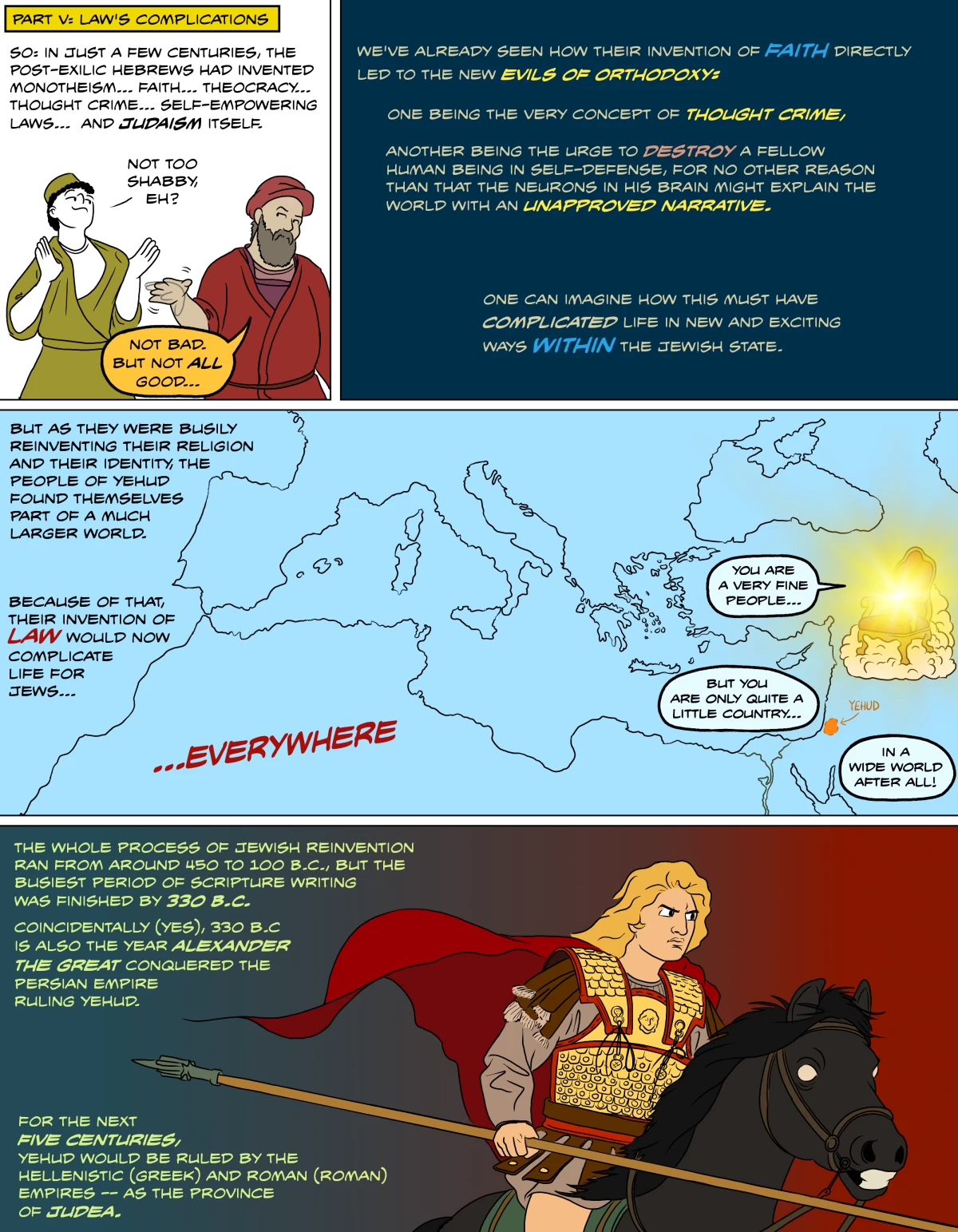
TITLE: Part V: Law’s Complications
Panel 1: The fez guy from pages 118 and 119 sticks his thumbs in his robe proudly, as if they were suspenders. An older bearded man in red and purple garb shakes his hand in a so-so gesture.
NARRATION:
So: In just a few centuries, the post-exilic Hebrews had invented monotheism… faith… theocracy… thought crime… self-empowering laws… and Judaism itself.
FEZ GUY:
Not too shabby, eh?
RED GUY:
Not bad. But not all good…
-=-
Panel 2: Narration box.
NARRATION:
We’ve already seen how their invention of faith directly led to the new evils of orthodoxy:
One being the very concept of thought crime,
Another being the urge to destroy a fellow human being in self-defense, for no other reason than that the neurons in his brain might explain the world with an unapproved narrative.
One can imagine how this must have complicated life in new and exciting ways within the Jewish state.
-=-
Panel 3: A map of the Mediterranean world. Tiny Yehud is shown in orange against a vast swath of blue. Above Yehud, a bright light speaks from an otherwise empty throne in the clouds.
NARRATION:
But as they were busily reinventing their religion and their identity, the people of Yehud found themselves part of a much larger world.
Because of that, their invention of law would now complicate life for Jews…
…EVERYWHERE
YAHWEH:
You are a very fine people…
But you are only quite a little country…
In a wide world after all!
-=-
Panel 4: Alexander the Great, clad in armor and a cape, and carrying a spear, gallops on his horse Bucephalus. He looks ahead with determination, his cape streaming out behind. Bucephalus’ eyes and teeth look evil.
NARRATION:
The whole process of Jewish reinvention ran from around 450 to 100 B.C., but the busiest period of scripture writing was finished by 330 B.C.
Coincidentally (yes), 300 B.C. is also the year Alexander the Great conquered the Persian Empire ruling Yehud.
For the next five centuries, Yehud would be ruled by the Hellenistic (Greek) and Roman (Roman) empires—as the province of Judea.

How/why/when did the standard English spelling change from Yehud to Judea?
In English, it’s generally written as Judah when referring to the period before Alexander, then Judea after.
Judah is the anglicized form of Yehudah, and Judea is the anglicized form of Iūdaea, which is how the Romans spelled Ιουδαΐα, which is how the Greeks approximated “Yehudah.” (The Latin and Greek words were both pronounced something like yoo-DAY-uh. How the J came to be pronounced like the two consonants in “Judge” is a whole nother story.)
In the comic, I’ve avoided the term Judah because it’s not quite accurate. “Judah” gets used to refer both to the kingdom of Yehudah, and to the Babylonian and Persian provinces of Yehud. But they were different things, and I thought the distinction was important enough to use the historical words. Well, the modern English transliteration of the historical words, anyway.
Any experts in historical linguistics out there—and I know you’re out there—please feel free to correct the heck out of this! (Grammar experts upset about “whole nother” are free to keep it to themselves.)
Also, if anyone has a better idea for how to draw the “kinda”/”so-so” hand gesture, I’m open to suggestions.
Just a plain palm up?
I think it works perfectly, but that’s just my personal neurons speaking.
lol (and thanks)
“…and the need to destroy a fellow human being, for no other reason than the neurons in his brain might explain the world with an unapproved narrative.”
So, not much change since then.