Constitutional Law
Part 2: “What Were They Thinking?”
Digression: “A History of Government in 6 Revolutions: From the Paleolithic to Philadelphia”
123. Inventing God and Law: You Gotta Have Faith
TITLE: Part Q: Rhetoric Becomes Reality
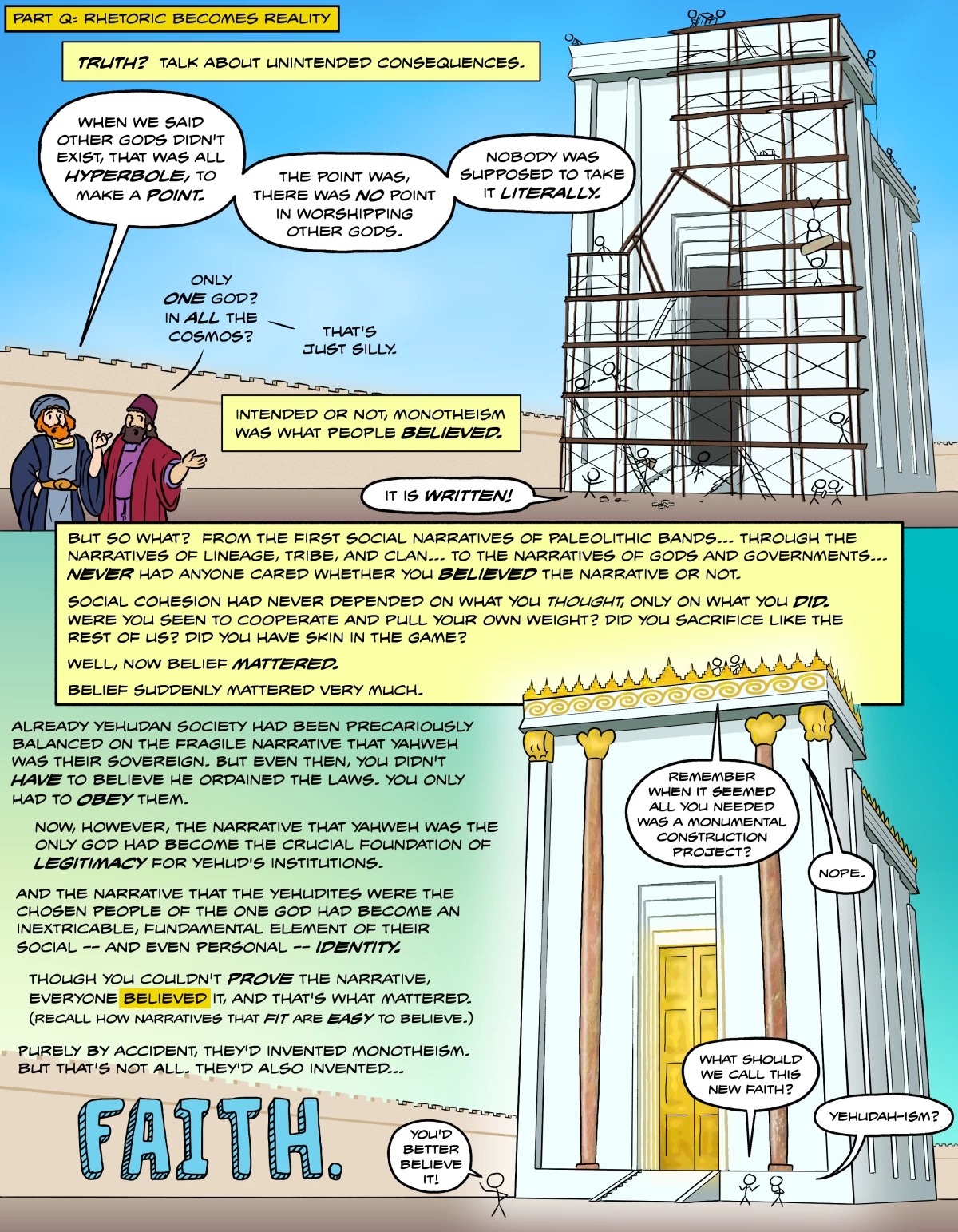
Panel 1: Jerusalem’s “Second Temple” is under construction. The edifice is tall and pale-colored, with several insets in the front face leading back to a large hole for a doorway, with steps leading up to it. The front of the building is covered in scaffolding, on which lots of people are working. Other people are working on the roof, and one holds a rope over the side. In the background, the walls surrounding the temple’s plaza appear already complete. In the foreground, two elite men are talking to one another. One has an orange beard, and is dressed in blue-gray robes and a turban. The other has a dark brown beard and is dressed in red and maroon with a fez-like headdress.
NARRATION:
TRUTH? Talk about unintended consequences.
BLUE-ROBED ELITE:
When we said other gods didn’t exist, that was all hyperbole, to make a point.
The point was, there was no point in worshipping other gods.
Nobody was supposed to take it literally.
RED-ROBED ELITE:
Only one god? In all the cosmos?
That’s just silly.
NARRATION:
Intended or not, monotheism was what people believed.
CONSTRUCTION WORKER:
It is WRITTEN!
-=-
Panel 2: Narration Box
NARRATION:
But so what? We know that, from the first social narratives of Paleolithic bands… through the narratives of lineage, tribe, and clan… to the narratives of gods and governments… never had anyone cared whether you believed the narrative or not.
Social cohesion had never depended on what you thought, only on what you did. Were you seen to cooperate and pull your own weight? Did you sacrifice like the rest of us? Did you have skin in the game?
Well, now belief mattered.
Belief suddenly mattered very much.
-=-
Panel 3: The second temple is now complete, and it’s so bright that it’s radiant in the daylight. The stepped-triangle crenellations around the roof are all covered in gold, as are the decorations of the molding below on the façade, the capitals atop the façade columns, and the recessed great doors. The two columns flanking the doors are made of pinkish-brown marble. The temple plaza’s walls recede into the background. Two people are standing on the roof, two others beside the front staircase, and a third stands farther out in front of the temple to face the reader.
NARRATION:
Already Yehudan society had been precariously balanced on the fragile narrative that Yahweh was their sovereign. But even then, you didn’t have to believe that he ordained the laws. You only had to obey them.
Now, however, the narrative that Yahweh was the only god had become the crucial foundation of legitimacy for Yehud’s institutions.
And the narrative that the Yehudites were the chosen people of the one god had become an inextricable, fundamental element of their social—and even personal—identity.
Though you couldn’t prove the narrative, everyone *BELIEVED* it, and that’s what mattered. (Recall how narratives that fit are easy to believe.)
Purely by accident, they’d invented monotheism.
But that’s not all. They’d also invented…
FAITH.
FOREGROUND MAN:
You’d better believe it!
ROOFTOP MAN 1:
Remember when it seemed all you needed was a monumental construction project?
ROOFTOP MAN 2:
Nope.
STAIRCASE MAN 1:
What should we call this new faith?
STAIRCASE MAN 2:
Yehudah-ism?
-=-
FOOTNOTE:
In cultures heavily influenced by the Abrahamic traditions of Judaism, Christianity, or Islam, faith these days is practically synonymous with religion. It’s such an obvious and natural fact that we refer to all world religions as “faiths.”
So it can be hard to realize how bafflingly weird this development seemed to everyone else back then, during the post-exilic, Second Temple period. Strict monotheism and religious faith were totally new. And to the Persians, Greeks, Egyptians, Romans… they made no sense.
Even today, this particular concept of faith—a requisite belief in one’s god and in the teachings of one’s received scriptures—isn’t really a thing in most other religious traditions. About half the world’s population grew up in such cultures (even factoring in Islam’s massive baby boom that’s going on).
That’s mildly interesting, I guess. But again, so what? Faith is nothing more than thoughts inside people’s heads, after all. What’s this got to do with government and law?